
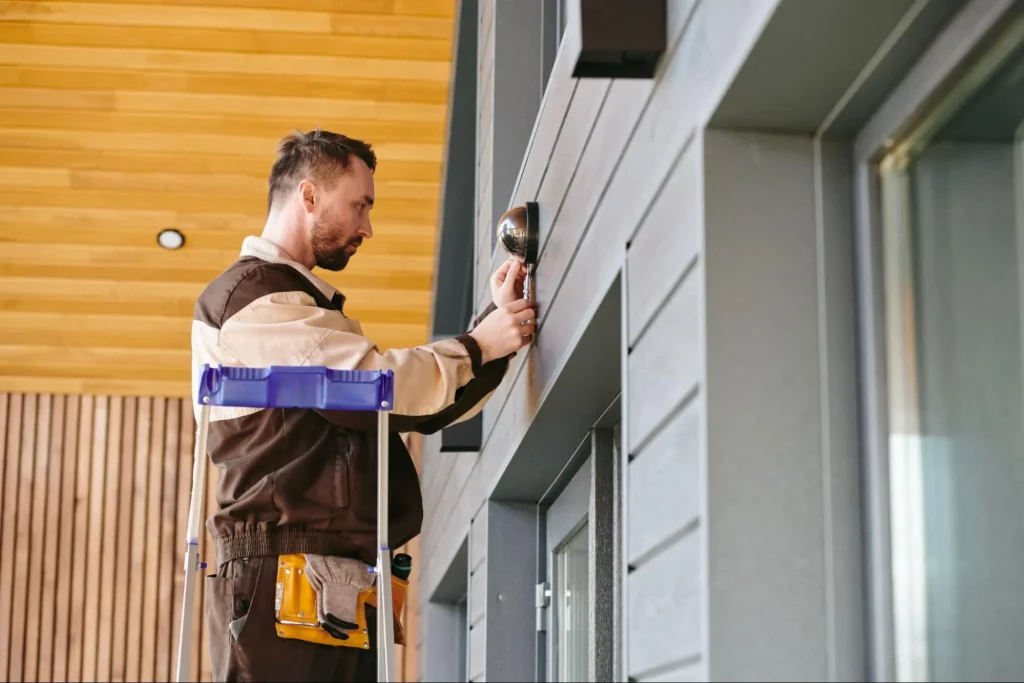

Most homeowners go about an exterior home remodel the wrong way around – they decide on the cladding color before they’ve given any thought to what’s underneath. In reality, the aesthetic choices need to be guided by the structural ones, not the other way around.
Before anything is stripped off or torn out, have a framing inspection – a builder or experienced cladding installer can check for moisture damage, rot, or termite activity in the timber studs and substrate. Find and fix the problems first, then pick a cladding.
The Moisture Layer People Skip
Most homeowners never see it in the glossy before-and-after photos, but the moisture barrier is probably the most important part of any recladding job. It goes in directly behind the new cladding, and honestly, it’s what separates a renovation that holds up for three decades from one that starts causing headaches by year five.
Sarking – the reflective foil membrane that sits behind the cladding – does two things. It stops moisture getting into the wall cavity, and it takes a decent chunk out of your heat loss by cutting down on thermal transfer through the wall. That second bit matters more than most people realise. Thermal bridging – where heat just travels straight through the structural frame is one of those invisible energy efficiency problems that a bare-framed wall does absolutely nothing about. If you’re recladding anyway, it’s the perfect time to get a continuous moisture barrier in and top up the wall cavity insulation. You’re improving the thermal envelope of the whole house without knocking out a single internal wall.
Same goes for windows and doors. If you’re replacing them or widening any openings as part of the work, the flashing needs upgrading at the same time – not as an afterthought. Water getting in at those junctions is the number one cause of timber rot in residential buildings. It creeps in slowly, you can’t see it happening, and by the time it shows up it’s already an expensive fix.
Choosing Materials That Earn Their Place
The trend for mixed-material exteriors – usually vertical cladding combined with timber accents – is about more than just creating a good-looking facade. When it’s all ticking along as it should, the use of different materials in your design reflects a kind of common-sense approach. Different materials deal with different exposures in different ways.
Fiber cement does well in a wide range of conditions. It’s dimensionally stable, so it doesn’t change with moisture and swell the way timber does, and it’s non-combustible, which can be significant in bushfire-prone regions. Bushfire-aware homeowners and builders in those areas will tell you that meeting or exceeding bushfire construction standards is a crucial consideration when it comes to product selection – in many cases, it’s a non-negotiable requirement of your local building code. Termite resistance is another ‘nice to have’ that’s worth getting serious about; unlike untreated timber cladding, fiber cement won’t get eaten.
For the timber accents that add so much warmth and texture to modern exteriors, where your material comes from counts. James Hardie Timber Supply WA products are made to perform in the specific conditions they’re sold in, and that sort of reliability is exactly what you should be looking for when the materials are slated for a long life out in the elements on the outside of your build.
Where Structural Work Intersects With Design
There are two exterior design moves often made in renovations that require engineering, not just a builder’s eye: extending eaves and adding cantilevered elements (like a modern covered entry or a sleek deck overhang).
Eaves and soffits are often the last things to get attention in a recladding project. But they’re visible from the street and they set the final proportions for the whole job. Extending an eave to create a more contemporary roofline changes the load distribution on the wall framing below it. Similarly, a cantilevered structure needs to be engineered to account for both dead load (the weight of the structure itself) and live load (wind, rain, foot traffic). Getting this wrong doesn’t just create an aesthetic problem – it’s a safety issue and a permit problem.
A building permit is needed whenever the exterior footprint of the house changes, when the load-bearing wall configuration changes, or with structural additions. It’s not just a chance for the city to extract another pound of flesh. You get a dated, official record that you can show your insurance company when your $20,000 recladding job springs a leak. Or show potential buyers when you sell.
The Return On Doing It Properly
Properly done exterior renovations ultimately return 10-15% on your investment (Housing Industry Association). Exterior renovations mean a lot more than a new coat of paint. We’re talking about the things nobody sees – the building paper, the flashing, the cladding itself. The stuff that keeps your house dry, warm, and standing.
The real value of exterior renovations is not just in the facelift, but in the extra decades they can add to your home’s life. A well-done reclad can protect your house for 50 years or more. That’s around twice the length of time you can reasonably expect to get from the cladding’s best-dressed rivals. A paint job looks great – for a little while – but works kind of like the emperor’s new clothes if that’s all you’re relying on.

Comments are closed.