
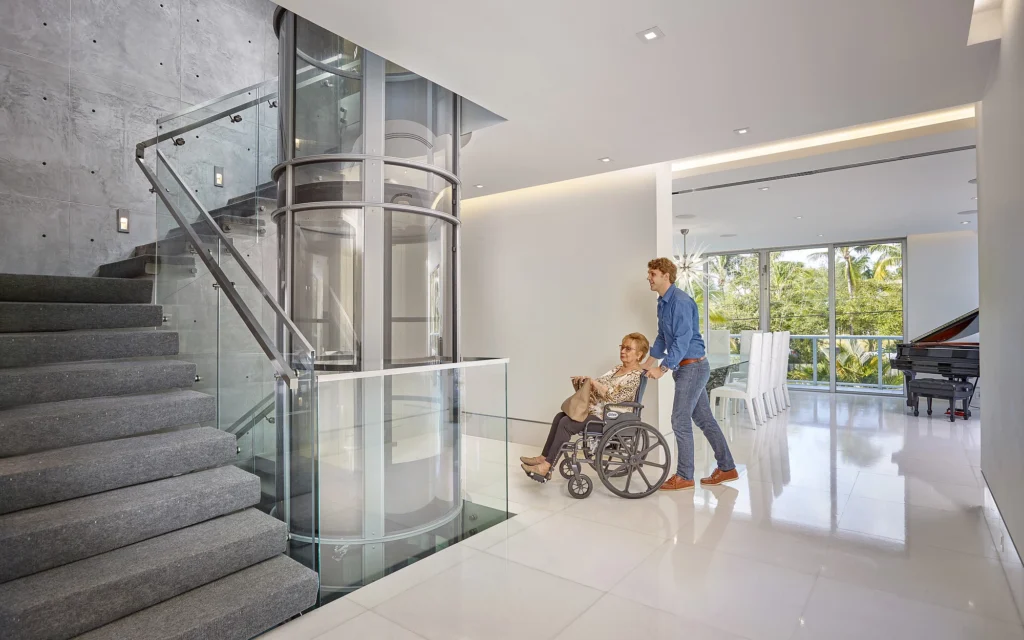

The smartest buildings are already looking at how they can adapt to an aging population, one that will soon be less able to climb stairs. And this means not just thinking of a stairlift somewhere in the corner of a schematic drawing, but fundamentally redesigning how a core of a building works.
From Compliance to Design Intent
Historically, accessible features could end up compromising the aesthetics of a beautiful space. Retrofitted accessible toilets created dead space awkwardly carved out of a functioning washroom. The shock of different ceiling heights in hallways pushed beyond the building’s original design to accommodate a passenger lift. A bulky grab rail that ruined a wall’s intended clean lines and created a ‘clinical’ feel in a hotel room.
This continues outside the home or office. The side entrance to a high-end retail store that screams “this is where the wheelchair users go”, leading to a cramped corner with no product displays. The ‘inclusive’ raised room at a museum exhibit that makes a viewing spot for wheelchair users, but at an angle where the work can’t be seen properly.
Now it’s clear that if the accessible design is sketched into the concept design of a building, it will be indistinguishable from the vision the architect had at the start. It can even elevate the overall aesthetic. Create and use wider corridors, and a sense of space solidifies. Flush thresholds open expansive views across the building and erase the boundary between outside and in.
Retrofitting Older Multi-Storey Buildings
The more difficult challenge we face is addressing the current housing stock. Lift provision just wasn’t part of the picture when the majority of multi-storey dwellings were constructed, and retrofitting them creates real constraints, structural walls, limited footprints, and no provision for the pit depth that traditional passenger lifts require. This is where modern platform lift technology has changed what’s actually possible. Screw and nut drive systems, for example, don’t need a deep excavation beneath the shaft. They operate from within the lift itself, which means they can be installed in spaces that would have been considered unsuitable ten years ago.
Consulting with platform lift specialists is often the first step in understanding what a specific building can accommodate, particularly when the goal is minimal structural intervention with a result that looks intentional rather than improvised. Only around 9% of homes in England currently meet even the four basic “visitable” accessibility standards. That gap represents an enormous number of buildings that will need to catch up, and the technology to do it without major reconstruction exists right now.
The Multi-Generational Home is Raising the Bar
Housing for multi-generational families has been growing consistently over time. The trend also brings new demands and pressure on rethinking how we envision the layout and design of a home. When a house needs to suit a grandparent with some level of restricted mobility and parents with young children simultaneously, moving vertically between floors demands a special design consideration and not just a luxury. A stairlift solves one problem.
It does not, however, address the pressing need on how, for example, a wheelchair user gets from the ground floor to a bedroom, or how a person carrying an infant and a laundry basket manages to negotiate a steep return staircase every single day. The homes that do this well spend no money on rework, as they plan for a compact lift at the stage of foundation and allocate the required space during construction even if they do not get the lift installed right away. The homes that do this well don’t necessarily have a lift in them (they can be added later if necessary), they simply have an added convenience if and when required.
Future-Proofing as a Commercial Argument
There is a financial argument for this that I think doesn’t get emphasized enough. An apartment, or house that can be used by someone at 35 and by the same person at 75, without any modification, has a larger potential market than one that can’t. And that includes people who would like to think they are anyway mostly making their housing purchase based on long-term practicality, not on their ability to get up the stairs or navigate the loo after they’ve had a hip replacement last year.
Aging in place is a real preference for many people. Designing a multi-storey home to accommodate that preference is quite possible. Designing to accommodate it after the building is built is either impossible or expensive as all get out. But the reality is that’s what’s currently happening. Either people are moving. Or they are reshaping the apartment. And more often than not, the facilities available after the remodel are not as nice as they were before.
Actually, smart home is starting to make this logic come full circle. There are voice-activated and app-controlled lift systems now on the market which eliminates the use of fine motor control completely, useful if you’ve got arthritis, or a neurological condition, but also likely to be appealing to the same group looking to get automated thermostat and lighting opportunities. Inclusivity features and premium features seem to be racing each other to the top.
What This Means For the Buildings Going up Now
Architecture that considers accessibility as part of the design within the budget, rather than a separate factor, creates buildings that are more functional for a larger group of users, and remain suitable for use for many more years. This is not just a moral standpoint but from a pragmatic perspective.
It is a fact that there is increasing pressure from the demographics. Technology can be employed to create accessible design. The architectural and design industry has developed using language making it easier for designers to follow these principles. The last step is to decide within the first stage of planning to construct a building that doesn’t need to be updated or exclude people in the future.

Comments are closed.