
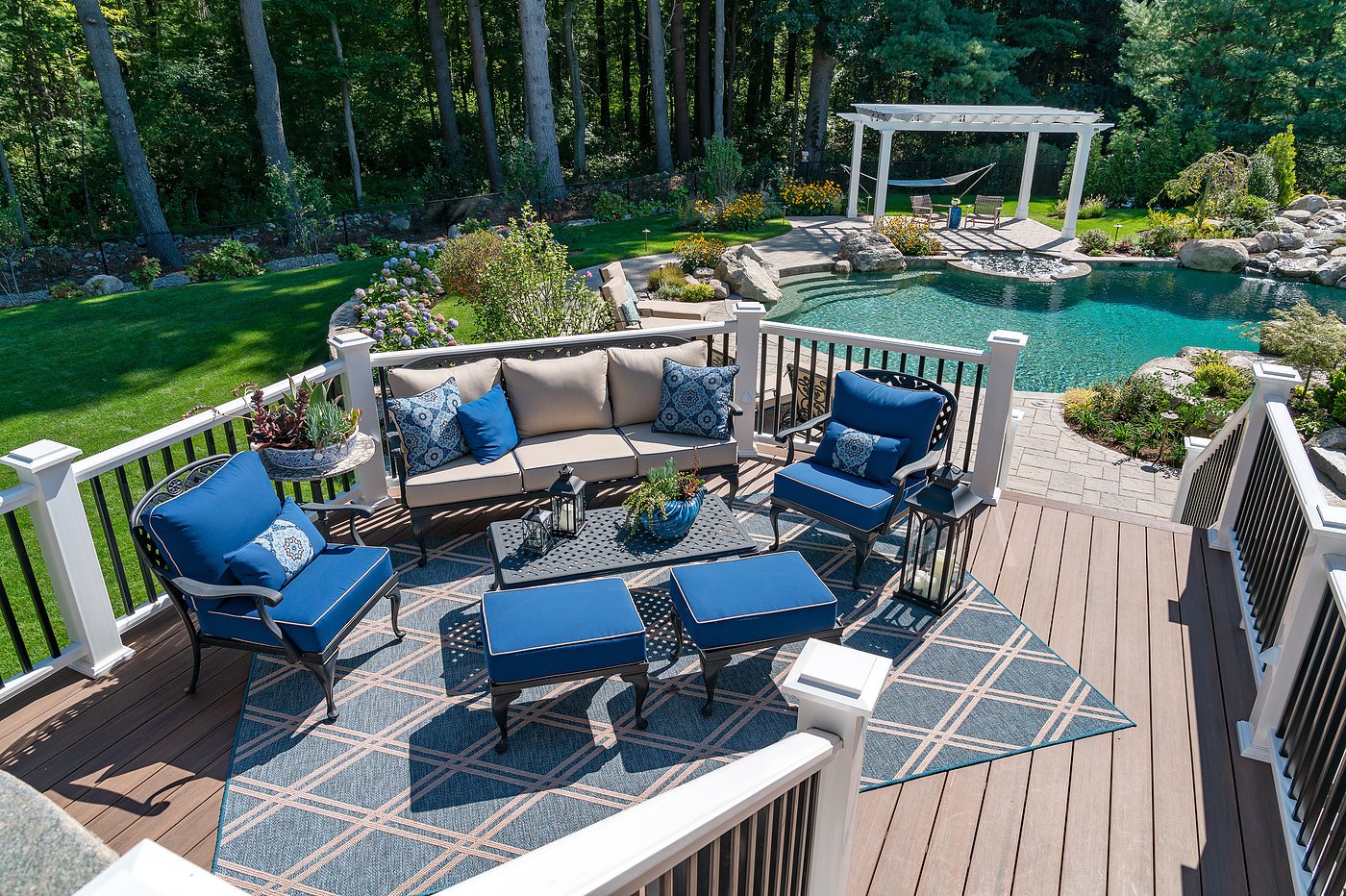

A small garden isn’t a problem to solve – it’s a design opportunity that is almost always guaranteed to improve a property – in those rare cases when the work put into creating a shaded sanctuary doesn’t pay off, the fault generally lies elsewhere in the overall offering. Small spaces provide focus, concentrate creative design decisions, and offer access to high-quality elements of garden design and materials that might be out of reach in a larger space. They also make it far easier to take risks.
Start With One Focal Point, Not Five
When you have a small yard, the first impulse is to want to put everything you can imagine into it. A fire pit, a raised garden bed, a dining set, a water feature. Unfortunately, the result is often a space that feels too busy rather than carefully considered.
A better approach is to select one primary feature and design everything else around that. It could be a custom seating structure running the width of the yard at the back, an outdoor kitchen with a pizza oven at its heart, or a plunge pool flush with the deck. The lighting, planting, and surface materials all complement that choice.
It is the heart of luxury minimalism as a design philosophy. The less your eye has to process, the more calm it intuits. And calm is exactly what you want from a relaxation-focused outdoor room.
Hardscaping And Visual Continuity
One of the best backyard renovation ideas happens to be one of the easiest: continue your internal flooring material outside. Whether it’s the same large-format tile or matching timber tones, bring the textural and colour tonality from your interior living room to your external deck or patio. If the eye can travel easily from one space to the next, the brain tells the body that the space is larger than it is, and that’s sort of the point.
Next, think perimeter-built seating instead of freestanding furniture. A beautifully made timber, stone, or rendered masonry bench running along the boundary walls free up the central floor area, which is crucial when you’re fitting eight people into a space that’s, oh, six metres wide. Storage space mined from underneath the benches tidies away all the usual backyard flotsam: cushions, kids’ rubbish, gardening equipment, and factory-sealed barbecue polymers that don’t weather well. You want to see none of it.
Permeable paving is another detail definitely worth steering into the material spec, particularly in the walled-in, access-challenged backyards of our inner-cities. You know the ones – the stormwater forms gushing waterfalls at the side of the house every four months. Cleverly designed pathways or patios that allow rainfall to leak unobtrusively through are good landscaping gold.
Water In A Tight Space
A pool in a small backyard? Well, not if it’s a compact water feature. Whether it’s a plunge pool, a spool (spa-pool combo), or a narrow lap pool running alongside a boundary wall, these options have matured as a category, allowing a level of resort-perfect luxury that often exceeds what could be achieved with a larger free-form space. Pair that with the right connection between indoors and out, and the right pool builders sydney can deliver that unattainable dream.
For this environment, a spool is ideal. Heated in winter, it becomes a spa; kept cool in summer, it’s a small pool. As a design object at the end of a long view, it looks good all year. Flank it against a rendered wall and up-light everlastingly cements the boutique-hotel aesthetic in place of the revamp-the-suburban-house vibe you’re probably trying to avoid.
The con job of course, is that it looks like no job at all. In reality, there are all the engineering and council tensions present when building a bigger pool. The access might be tight, the council setbacks and soil in urban situations will all affect what you can build and at what cost. A well-experienced pool builder has knowledge of these features and will counsel you on a look that fits – rather than offering a glossy concept which encounters reality during the engagement phase.
Vertical Space And Lighting After Dark
Small outdoor areas quickly run out of floor space. The solution isn’t to forgo more vegetation, but to create it vertically. Gardens set up vertically on boundary walls, climbing plants on timber battens, and tall screening plants like bamboo or cut hedges all contribute biophilic texture without taking any surface space.
Privacy screening should be really focused. Slatted timber fencing at around 2.1 meters establishes an enclosure without the suffocating effect of solid walls. That sense of containment – of being in a compartment rather than an exposed strip of grass – makes you want to be in a backyard.
Lighting is the other major role. Lantern strings hanging above push space utilization far into the night, low path lighting and plant lighting create depth and warmth. A well-lit small yard at night can feel honestly spectacular in a way that a floodlit large yard can’t.
The Investment Case
There’s also a pragmatic argument here. The Real Estate Institute of Australia says good outdoor living areas can add 10% to 15% to the value of a property in high-density urban markets. That’s a solid return for spending on a renovation that’ll also enhance daily lifestyle.
The quality of materials is more important in a small space than any other criterion because when there’s less of it, the finish is more evident. The miserable ping of cheap decking, the hollow ring of poorly laid pavers, or poorly specified outdoor furniture will be clear as day in a small yard.
Small yards are all about the detail. Get that right and treat your yard not as a limitation, but as a brief and the result will be something that performs far above its square footage.

Comments are closed.